
Palate Case Study
Palate
A taste archetype app that tells you exactly what to order
A consumer app built from scratch using AI as design partner, development environment, and iteration loop. No engineering background. 0 lines of code written by hand.
My role
Product, Brand, Design, Strategy
Timeline
2025 – 2026
Stack
Vanilla JS · Vercel · Upstash Redis · Claude API
Live at
knowyourpalate.com
The Product
Know what to order
A 13-question quiz assigns you one of 11 taste archetypes. Point your camera at any restaurant menu and Palate tells you exactly what to order: ranked picks with reasoning, personalized to how you actually eat. If a recommendation doesn't fit, dismiss it and get the next best option.
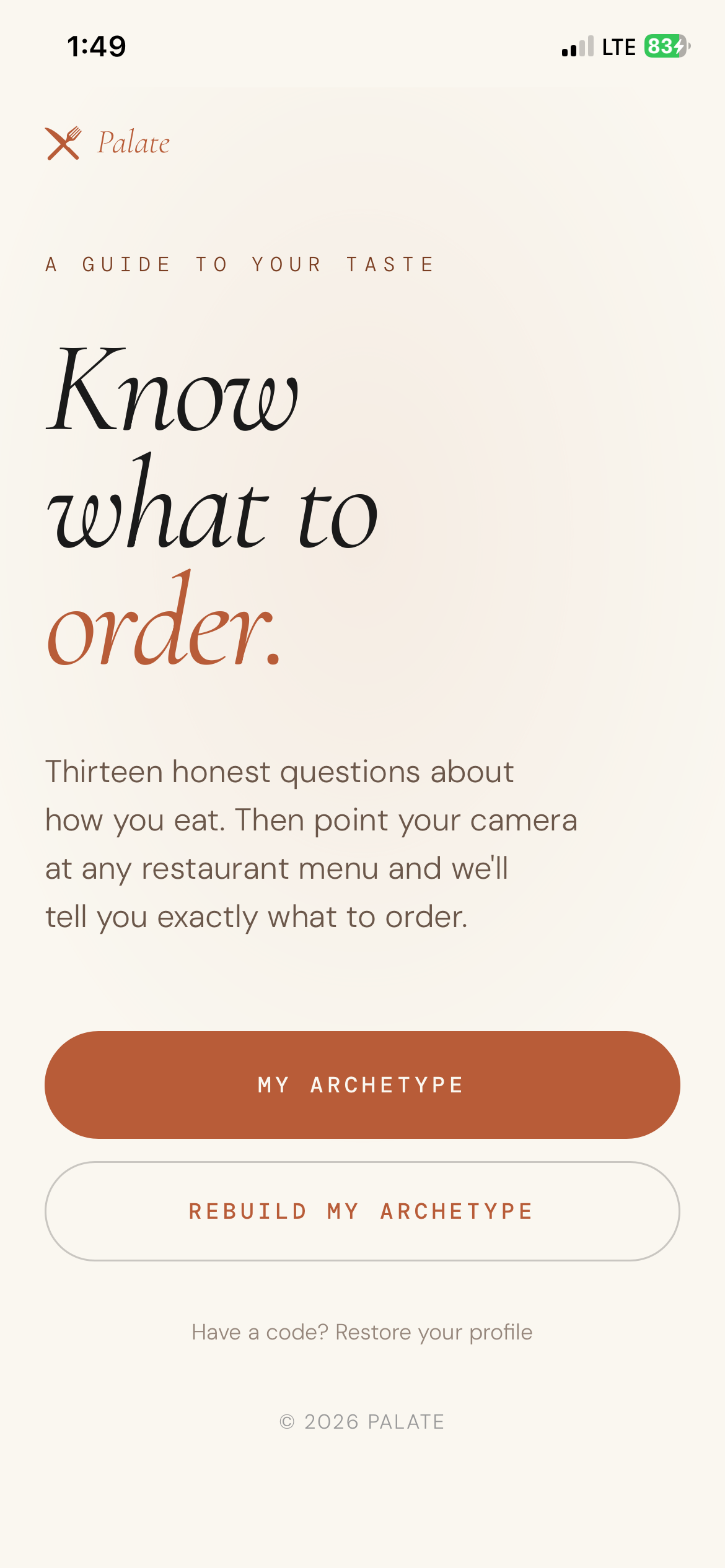
Landing: state-aware based on profile status
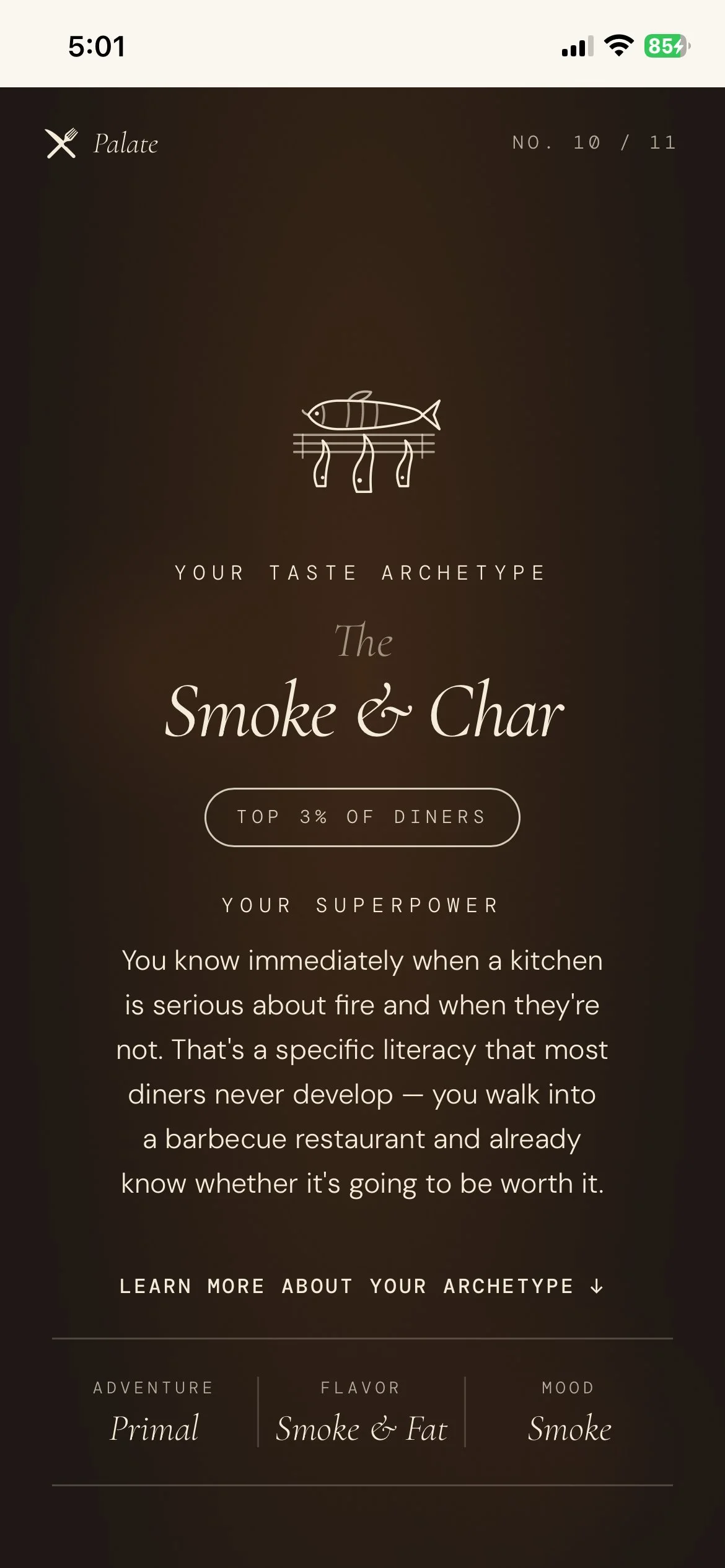
Archetype reveal: superpower, traits, expand for more
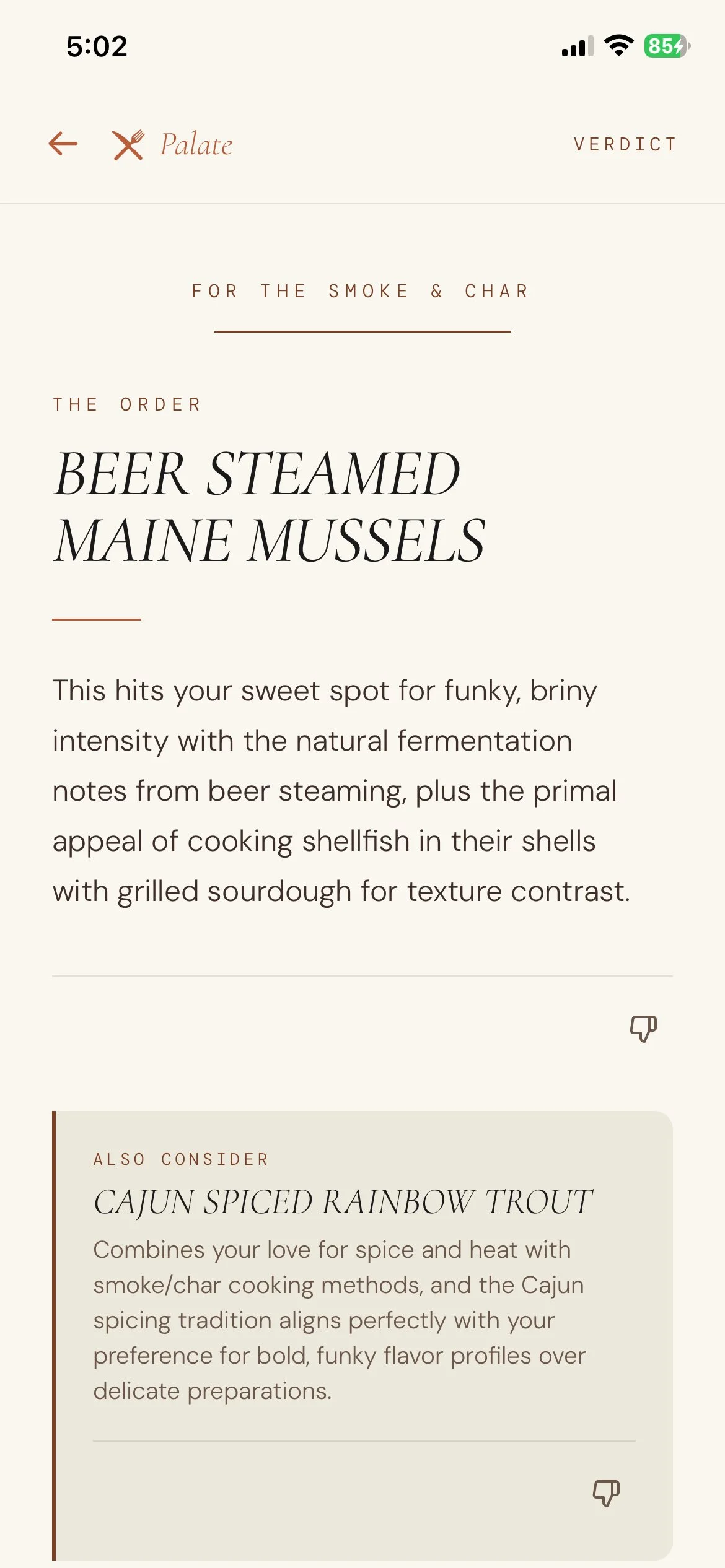
Recommendations: ranked picks, dismiss and refresh
The Idea
It started with green chiles
My wife and I were finishing lunch at Fool's Errand in Boston when someone at another table got the chicken milanese sliders. She said I probably would have ordered those. She wasn't wrong. I'd almost skipped the regular sliders because of green chiles. The regular sliders were better. And I realized I'd nearly made the wrong call not because I don't know what I like, but because I had no real framework for how I actually eat.
That lunch is where Palate started.
Product strategy
IA
Brand identity
AI tool direction
UX design
Design systems
Prompt engineering
Voice and tone
How It Was Built
Design the system. Build the MVP. Refine with feedback.
The product was designed in conversation before a line of code was written: quiz architecture, scoring dimensions, archetype logic, the profile-as-prompt structure. Then the MVP shipped as a single HTML file on Vercel. Then real users gave feedback, and the system was refined.
-
Every recommendation call sends Claude a natural language profile built from quiz answers. It reads like a knowledgeable friend describing you to a chef. That's what makes recommendations feel personal rather than algorithmic.
-
A sentence builder captures occasion, company, and hunger right before the scan: "I'm having a quick meal with just myself and I'm a little hungry." Same information as three selector rows. Completely different feel.
-
Early copy was personality-assertive: "You are the person who..." Users found it presumptuous. The rewrite shifted to preference-based: "You gravitate toward..." Same information, framed as observation rather than declaration.
-
High-adventure heat lovers were falling into the wrong archetype. One question rewarded two opposite behaviors identically. A flavor signal mapped to the wrong category. All four fixed by debugging against the actual implementation, not the design spec.
Visual Design
Claude Design as a creative partner
Once the MVP was validated, the visual language was developed inside Claude's design tools. The brief: warm, editorial, usable in ambient restaurant light. Each of the eleven archetypes has its own color palette: the Slow Heat Seeker arrives in warm blush, the Smoke & Char in deep brown. Three typefaces, strictly used. One fine-line SVG illustration per archetype. The PWA icon, Ember Bloom, was chosen from six named directions explored in Claude Design.
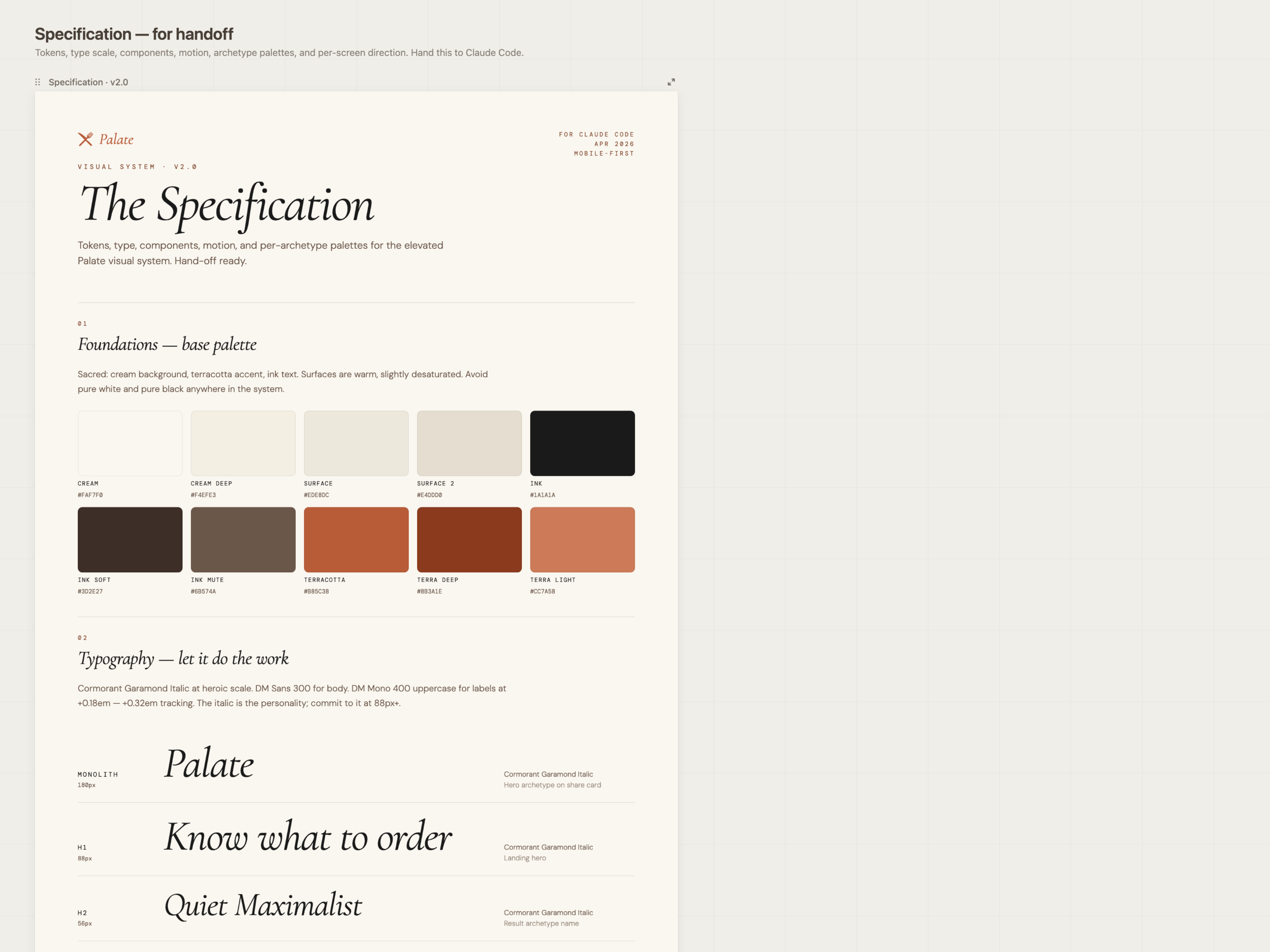
Color system and typography exploration
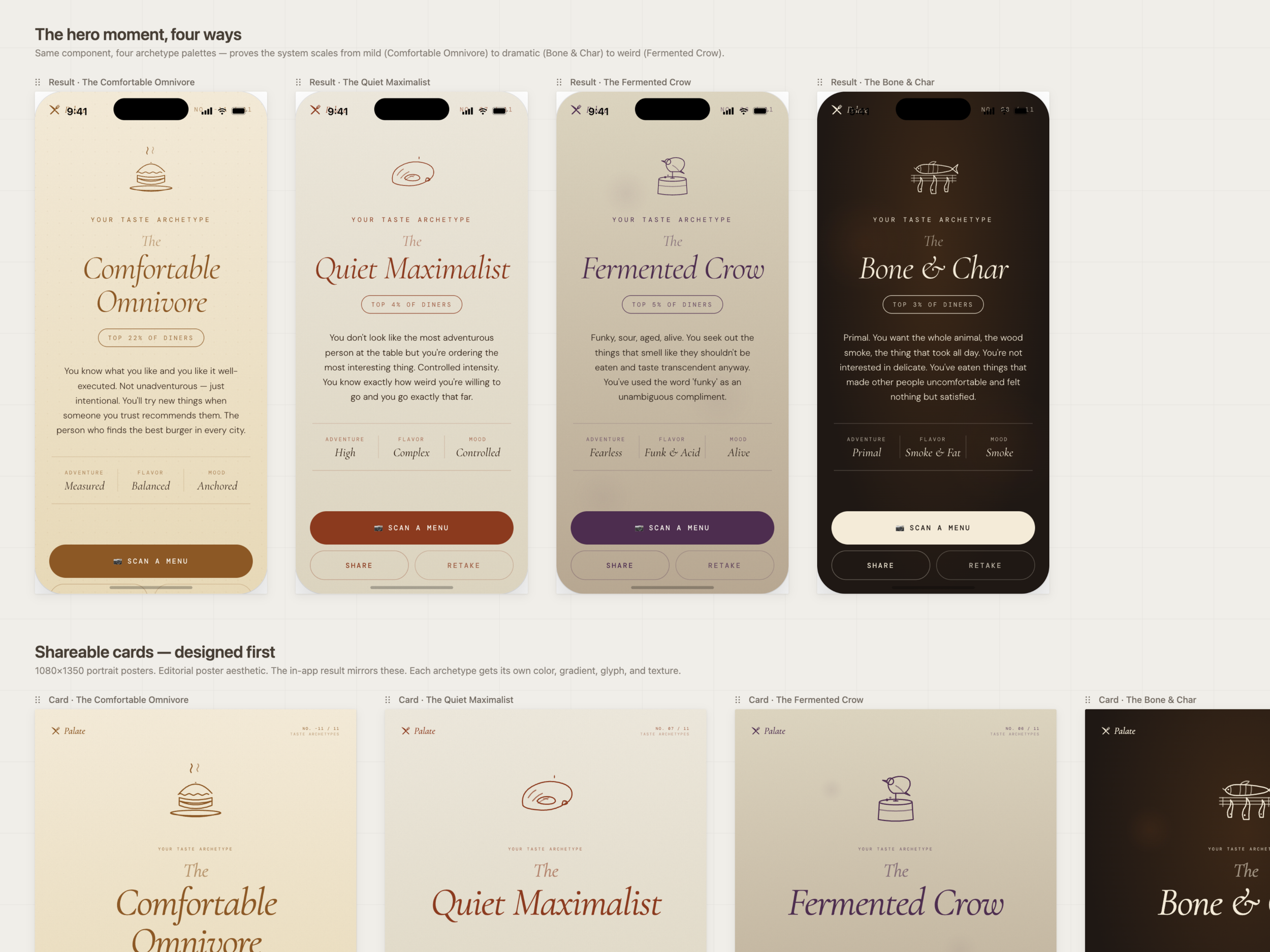
Per-archetype color palette system
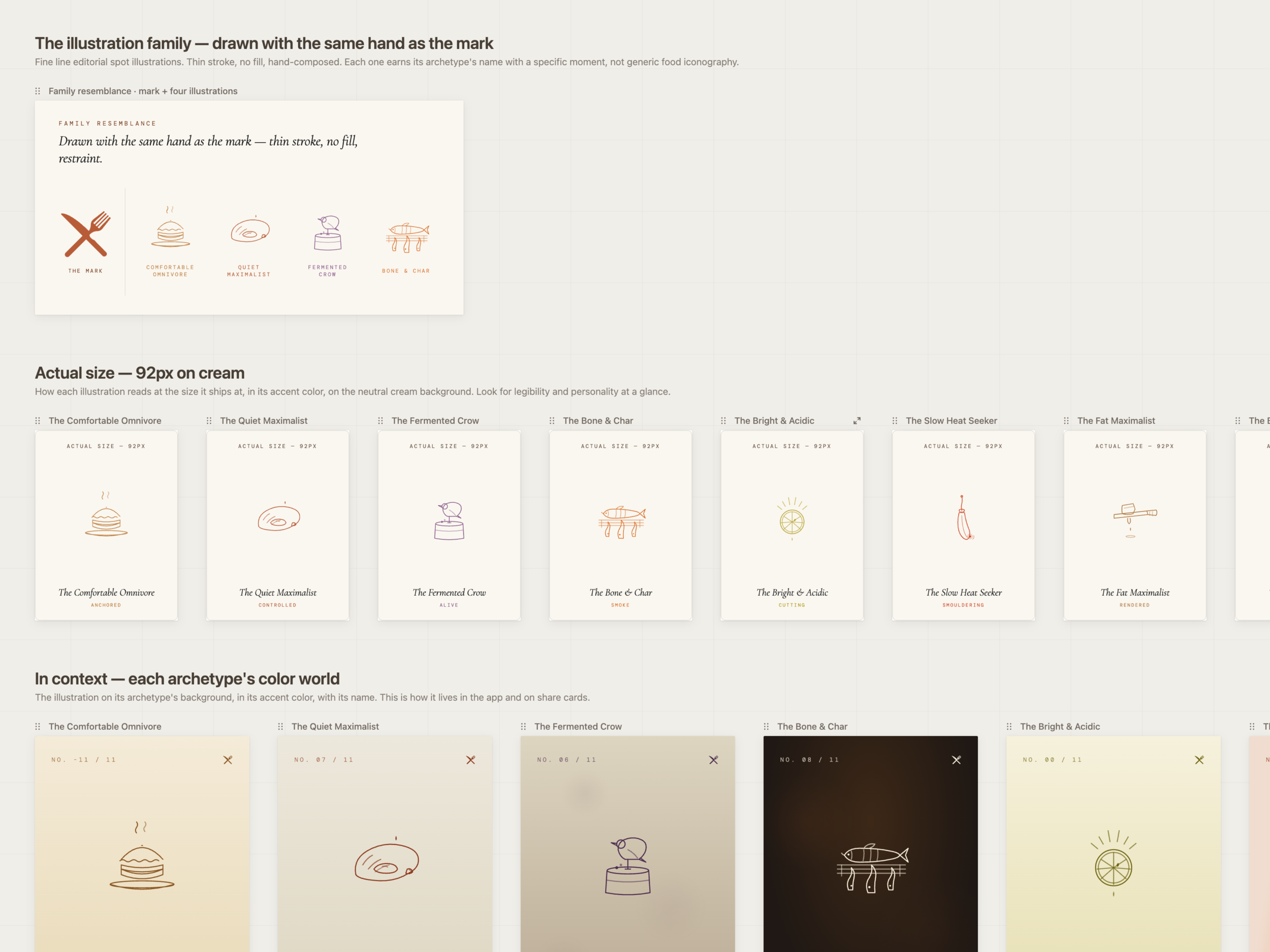
Archetype glyph illustration system
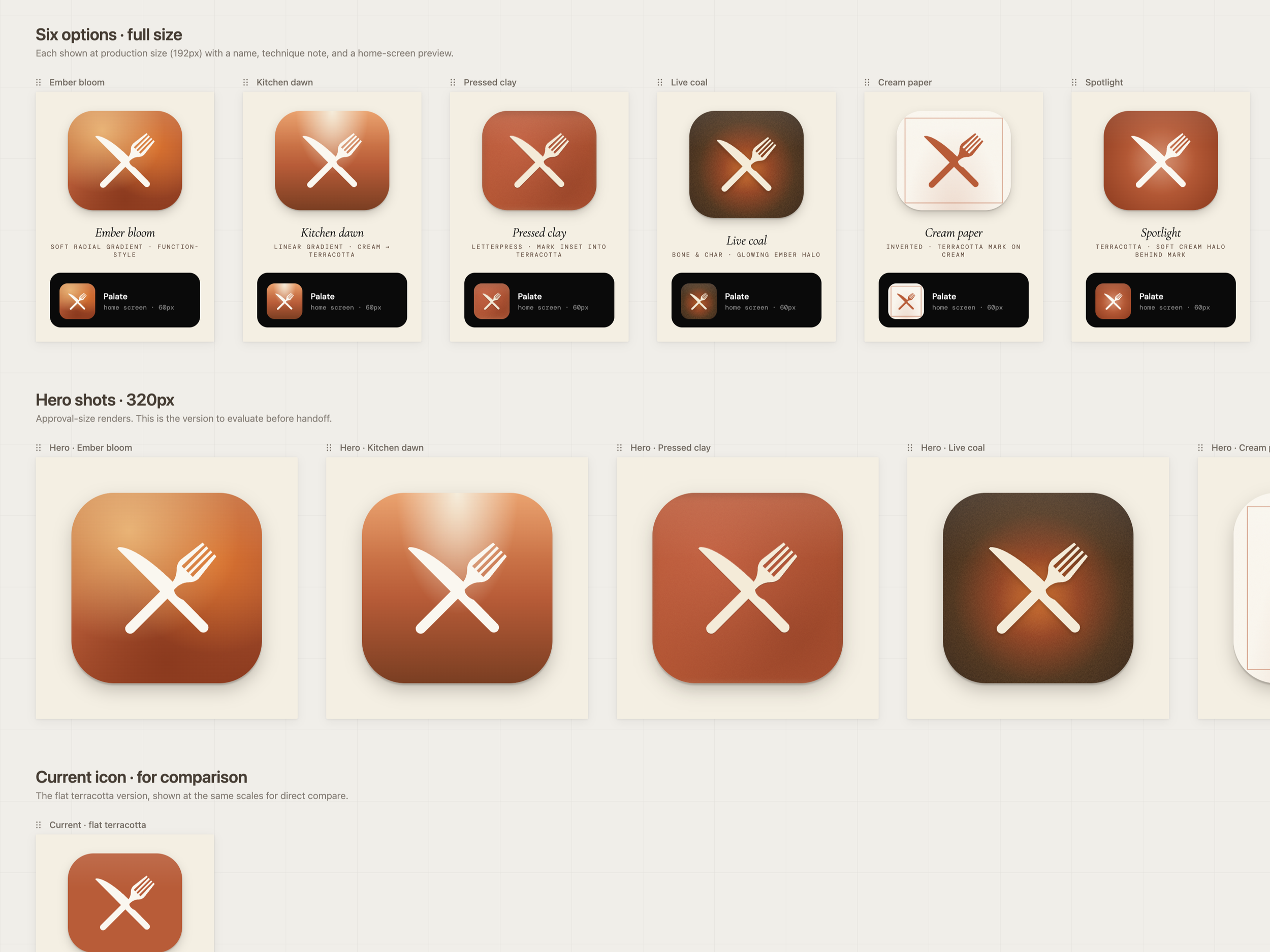
Six PWA icon directions, Ember Bloom selected
Validation
58 users. 34 cities. Week one.
The first users were friends and family. Within 48 hours, Facebook referral traffic appeared with no paid promotion: someone had shared the link organically. Feedback was direct and immediately actioned. Two users independently flagged the same answer option as unclear: that's the signal threshold for a change. 5 minutes 48 seconds average engagement time confirmed people were finishing the quiz, reading their archetype, and coming back, not bouncing.
11
Taste archetypes, each with its own palette, glyph, superpower, and expandable deep-read
34
Cities with active users in week one, no paid acquisition, no formal launch
5m 48s
Average engagement time per active user, week one
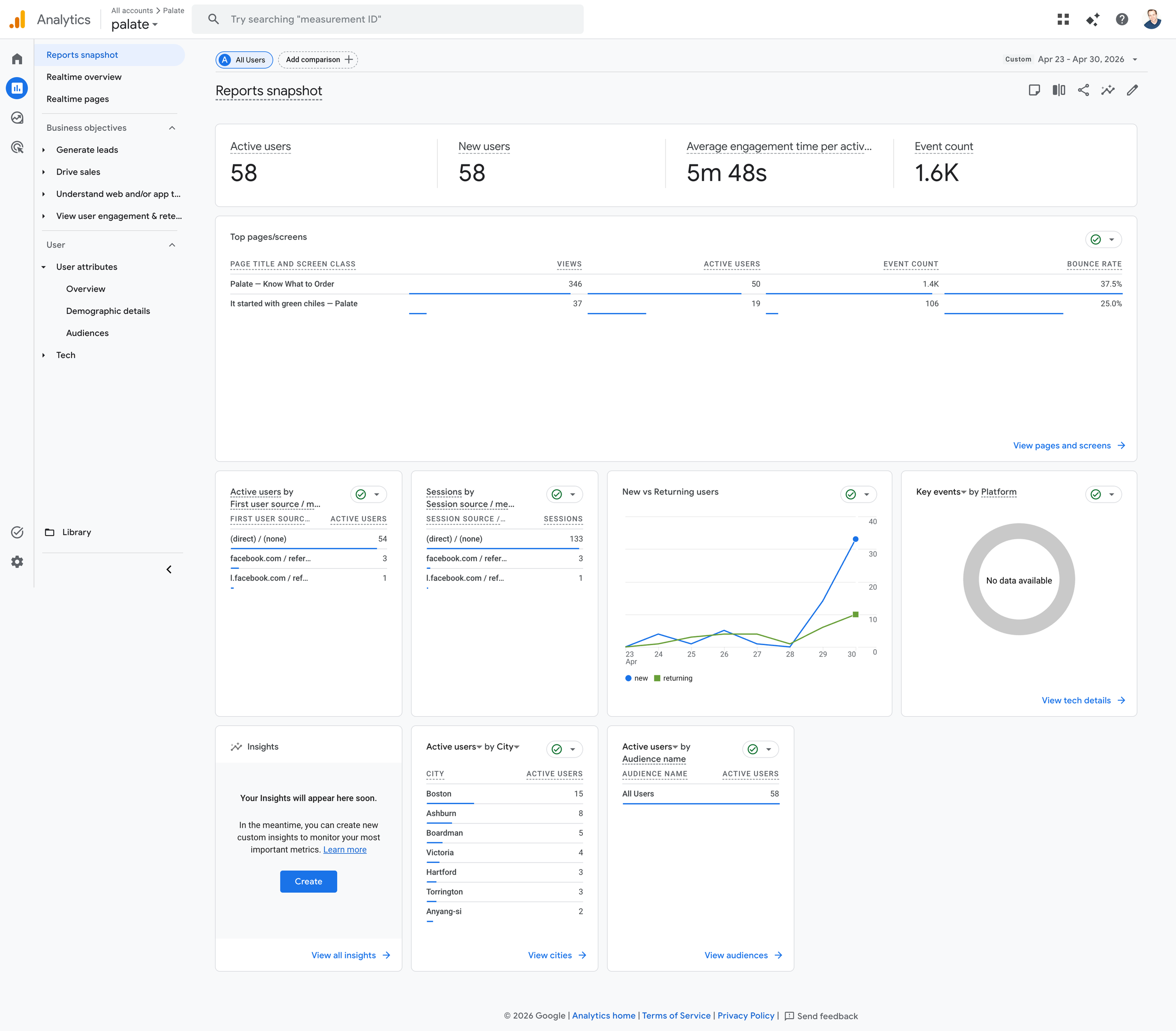
GA4: 58 active users, 34 cities, 5m 48s average engagement, week one
What’s Next
A deliberate watch-and-wait phase
Palate is in a 60–90 day retention window. The question: do people come back to scan menus after their first session, without being prompted? That answer determines what comes next: login and account infrastructure, feedback persistence, drinks mode, and eventually a native App Store wrapper. Each phase is contingent on the one before it working.
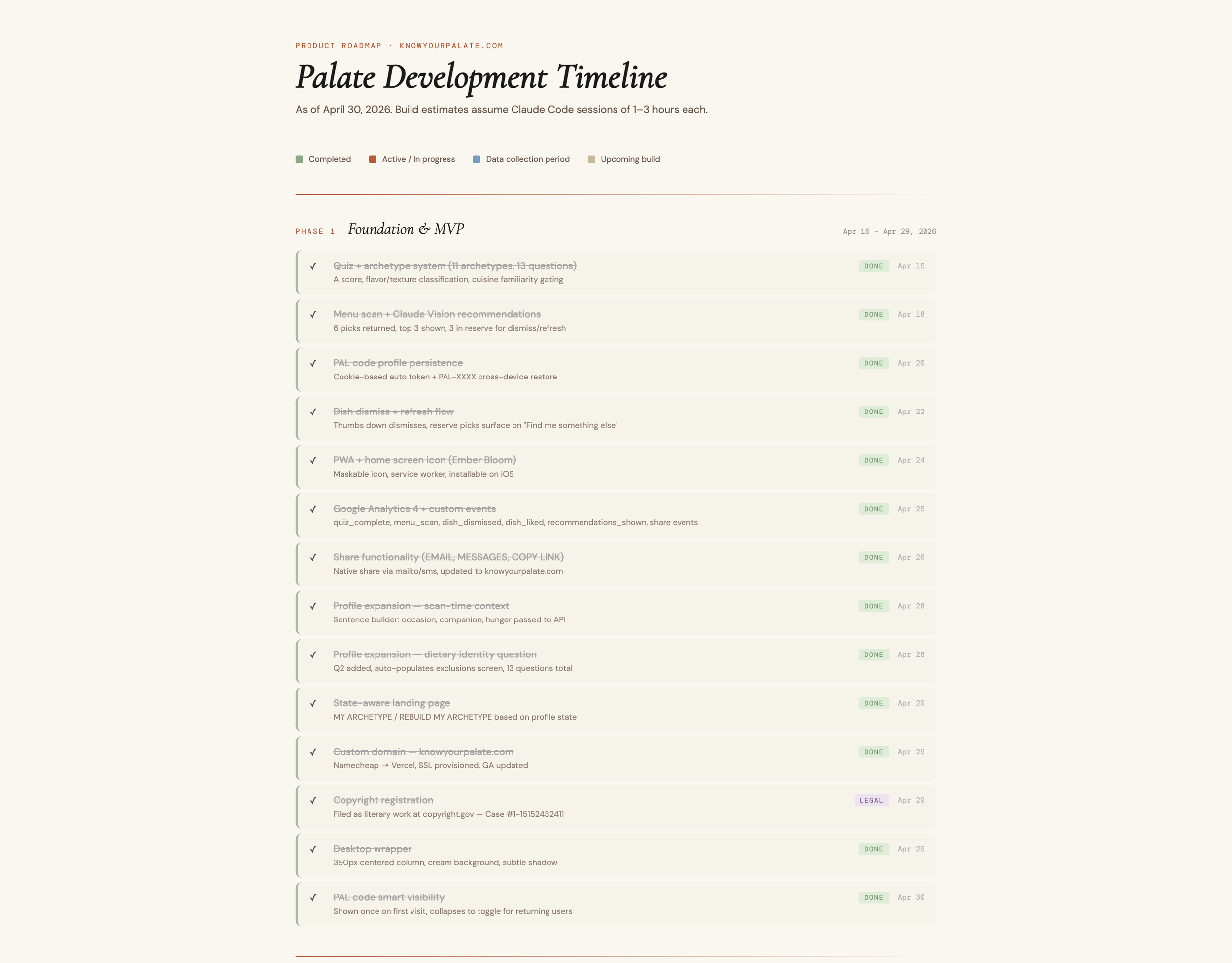
Product roadmap: six phases from foundation through feature expansion, April–December 2026
What This is About
The job of the product is to work at the table
Everything about Palate is oriented toward a single moment: a person sitting down at a restaurant they've never been to, holding a menu they've never seen. The quiz, the archetype, the design, the prompt engineering: all of it exists to make that moment better.
"The constraint now is clarity of thinking, not access to implementation. I built a production-deployed consumer app with a proprietary classification system, a custom design language, and real users in 34 cities. Without writing a line of code."
What I brought was product thinking: what the system should measure, how archetypes should be framed, when copy was doing the wrong job, when a scoring bug was misclassifying real people. The tools handled everything else. That's the argument Palate makes, not just as a product, but as a way of working.